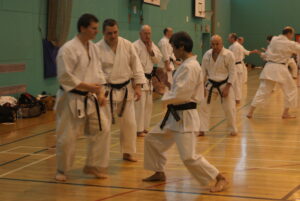
JKF Wadokai is the representative member for Wadoryu Karatedo within the Japan Karate Federation (JKF). Wadokai was established in April 1934, originally under the name ‘Dai Nippon Karate Shinko Club‘. At that time it consisted of karate members – primarily medical university students – training closely with the group leader, Otsuka Hironori. The group was formed for the purpose of participating in the 1934 Tenran-jiai which was held on 4th and 5th May.
The group expanded to include several more university clubs so that by 1938, it consisted of nine university clubs. In addition, a headquarters class was established at the Yagyuryu fencing dojo owned by Kubo Gihachiro and the group name was changed to ‘Dai Nippon Karatedo Shinbukai‘.
The name ‘Wadoryu‘ (和道流) was created in 1938 and was used for when the group began to participate in the annual martial arts festival hosted by the ‘Dai Nippon Butokukai’ (an organisation set up to promote the practice of martial arts, which had its headquarters in Kyoto). In particular, the 1940 demonstration was an epoch event in the history of karate, as this festival – thought to be the largest gathering ever held by the Butokukai – had each karate school register their names. Apart from Wadoryu, the other schools registered were Shotokanryu, Shitoryu, Shindo Jinenryu, Gojuryu, Kushinryu and Kosukunryu/Kushankuryu (now Matsubayashi Shorinryu). According to the records of this event, Wadoryu were the largest karate group attending with some 49 participants listed.
Note that the character ‘Wa’ (和) in ‘Wadoryu‘ has several means. It’s primary meaning is peace or harmony, but it can also mean Japan or Japanese. The original meaning then, was probably to imply ‘the Japanese school’ of karate. Subsequently, more emphasis was placed on the peace or harmony interpretation, borrowing from the Kodokan Judo philosophy of mutual cooperation and development.
In the post-War era, Wadoryu practice resumed in the university clubs and also began to be practised at private clubs, businesses and eventually schools. In this sense, it followed a similar path to other karate groups of the time, but Wadoryu became popular among university clubs and grew to be one of the four dominant schools of karate.
Late in the 1950’s, karate began to be spread overseas. Wadoryu karate quickly took root in Europe, due to the pioneering efforts of Suzuki Tatsuo. Suzuki, along with two other Wadoryu karateka Arakawa Toru and Takashima Hajime, travelled through Europe and the USA in 1964, giving demonstrations of karate. After returning to Japan, Suzuki decided to go abroad to teach karate and accepted an invitation to teach in London starting in January 1965.

Over subsequent years, he brought over dozens of assistant instructors to help spread Wadoryu and built a strong base of clubs across the UK and Europe – in fact over 40 young men and one woman came from Japan and taught karate professionally in the period 1965 – 1980. Not all instructors came to Europe under Suzuki’s wing – both Kojima Tetsuya for example in Belgium and Ohgami Shingo in Sweden, arrived independently, but they cooperated with the organisation Suzuki had established.
Today, the Wadokai group has expanded with representative branches all over the world. Most branches try to maintain a close connection with the headquarters in Japan, which arranges international seminars and allocate teachers from the JKF Wadokai Technical Committee. Periodic international competitions are held with Japan remaining the host for the world championship events. The Technical Committee set and maintain the standards for Dan gradings (black belt exams) and authorise examiners which allows branch members to hold examinations too. Examinations for 6th Dan and above are usually held in Japan once a year. Although there are now lots of groups training Wadoryu style karate, JKF Wadokai undoubtedly sets the standard due to the more rigorous examination system which ensures a thorough peer review approach is maintained.
What is Wadoryu Karate?
Wadoryu Karatedo is a karate style developed from Okinawan karate but strongly influenced by old style Japanese martial arts. Traditionally it is described as a blend of Okinawan karate and Japanese jujutsu (specifically Shinto Yoshinryu jujutsu) but this is not really the case. The founder, Otsuka Hironori trained in Shinto Yoshinryu when he was a teenager and then he practised other styles of jujutsu, most notably a school called Yoshin Koryu and later, Shinpen Igaryu jujutsu. However, whilst this may have some bearing on the early formulation of his approach to karate, it is more likely the influence of Kubo Gihachiro’s Yagyuryu which led to the specific features which we recognise in Wadoryu. These include careful observation of distance and timing, and a highly developed footwork which distinguishes the style from other forms of karate. The direct jujutsu element of Wadoryu is quite limited – there is no shimewaza for example and only limited throwing techniques.